
An Interview with Author Kate Moore
- Breelyn Lester
- Mar 3
- 7 min read


BL: While your career has been full of variety in the literary world, the source of your focus on the radium girls actually came from directing a play- can you tell us about your background in theatre?
KM: I have always loved theatre and performing; in a parallel universe I am a professional actress instead of a writer! At university I performed in over twenty different productions across the three years, sometimes acting in two different plays in the same week, and also performed as part of the National Student Theatre Company at the Edinburgh Fringe Festival, where our devised show was acclaimed by The Sunday Times as “the best dance I have ever seen from a student company”. When giving talks in schools, I always advise students to continue to nurture their passions, no matter where their lives may lead –because, for me, continuing to nurture my passion for theatre has unexpectedly taken me on the most incredible journey. After university, I chose to pursue a career in publishing; I worked as a book editor and then editorial director for over a decade, before becoming a full-time writer. However, I never gave up on my love of performing and continued to act in
fringe theatre shows in my spare time. In 2014 I made my directorial debut with a production of Lorca’s Blood Wedding. I enjoyed the experience so much that just a week after that show ended, I sat on my couch googling “great plays for women” because I wanted to direct again. That google search led me to find the play I directed about the radium girls, These Shining Lives by Melanie Marnich. My research as a director for the play exposed the shocking fact that no book existed which told the story of the individual radium girls. That in turn led me to write my narrative non-fiction history book about the women, which has transformed my life
in so many ways. I still love theatre today, though at the moment my “stage time” is limited to the in-person talks I give about my books. However, I know that I will return to the stage as an actress in the future, when I have more time to dedicate to that lifelong passion. I’ve played some amazing roles over the years, including Paulina in The Winter’s Tale, Beatrice- Joanna in The Changeling, Fabiana Aziza Cunningham in The Last Days of Judas Iscariot and Margery in Hand to God (complete with Southern American accent).
BL: Tell us about your favorite independent bookstore(s).
KM: I’ve been lucky enough to visit some amazing local bookstores. Favourites include Prairie Fox Books in Ottawa, Illinois and Our Town Books in Jacksonville, Illinois. Well worth a visit if you’re in the area!


BL: What's your favorite drink?
KM: Ooh – so hard to answer! Alcoholic: gin and tonic, Cosmopolitan or a lovely glass of Rioja. Soft: freshly squeezed orange juice or water.
BL: You’ve mentioned in previous interviews that you have years of work and research ahead of your third book in this genre, and have kept the cards close to your chest. Assuming that you aren’t ready to reveal the topic, can you tell us something non-revealing about your research process like an unexpectedly helpful resource or surprisingly difficult piece of information to find, either from your previous or upcoming works?
KM: I’m not quite ready to reveal the topic. Though I know the bare bones of the story I’m going to tell next, I don’t yet know how I’m going to tell it and am also still deep in research, so surprising things may yet emerge. I find I like to figure out how to talk about my topic before revealing it. I can say that it’s American history and that I hope the story will appeal to those who enjoyed both my previous history books.
To answer your question, what I will say about the research process is that it’s never straightforward and there are always tangents! You start with what you know is relevant: for example, court transcripts and memoirs (both those written by your actual characters or by people from the same era/profession/town, etc.). But then there’ll be a mention of something in those sources – an event, a connection between characters, a person, an illness – which will send you scrambling to research that. And I have to say I love those moments, but it does make the whole process rather time-consuming. I’ve also found over the years that you don’t know, when you start, exactly what is going to be relevant to your book. However, I think it
makes it a better book to research widely, because that’s when your net catches those unexpected connections that, oftentimes, no other researcher has made before you. Top tip: the website HathiTrust for free, digital copies of old, at times obscure books.
BL: Are you a pen and paper draft-writer, or do you start on a word processor? What
mediums do you prefer? (Ex. Pilot pens, Scrivener, Microsoft Word, etc.)
KM: I write on my laptop in Word, Times New Roman, size 12, double spaced. Funny the things that must be “right”! I might make notes on paper when I’m researching in an archive, but in general everything for me is on my computer. The “Find” button is my friend…
BL: In your research for The Radium Girls, did you find anything revealing about the
number of workers at the factory who were the children of immigrants? There has
been speculation about scientists who used personal protective equipment when the female factory workers didn’t, as if they had knowledge not yet made public. Did you find any evidence to suggest this or that children of immigrants could’ve been
targeted for hire?
KM: I found no evidence that children of immigrants were specifically targeted for hire, but it was a job that large numbers of that demographic did. I did find evidence that the dial-painters who were “lucky” enough to secure jobs often subsequently recruited family members and friends, so it’s understandable that the workforce skewed to that one demographic. I find it interesting that of all the photographs I’ve seen of the dial-painters from the 1920s, they are all white women of European descent. I think this was because dial-painting was seen as “the elite job for the poor working girls” and employers were probably racist in giving only white women a chance at this so-called “elite job.” There is ample evidence that scientists used personal protective equipment but the female factory workers didn’t. This was because it had been proven beyond all doubt that handling large amounts of radium was dangerous and potentially fatal. The women handled minute amounts, and at the time they believed such small quantities were not only safe, but actively
beneficial to health. However, the radium companies were the ones who commissioned and published the research that underpinned that belief – and were also, coincidentally, the ones who supplied the radium to entrepreneurs cashing in on that belief.
BL: What’s your writing set up like? Do you have any particular candle or mood-setting things like a playlist?
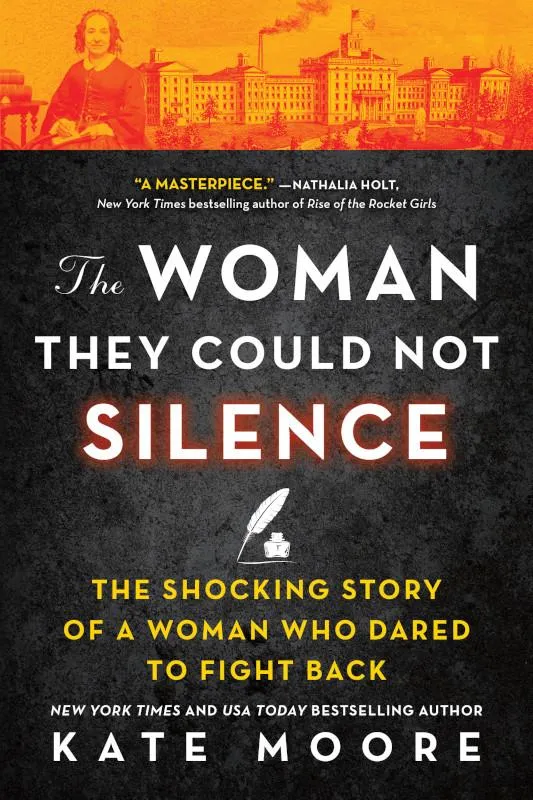
EM: I just need a small table and a chair. I have my laptop raised up (usually on a board game box) and type on a separate keyboard. I wrote The Radium Girls in our kitchen and The Woman They Could Not Silence in our newly decorated, sparsely furnished, tiny study. I like to listen to music when I work. When I’m researching, I can listen to things with lyrics and really vary the style, everything from folk to country, pop to musicals. When I’m writing, however, I prefer instrumental music and am a huge fan of Ludovico Einaudi; film soundtracks are also inspiring. No candles! I’m usually cold so I might wear fingerless gloves and/or this huge fluffy Traitors-style cloak that I have. If they’re available, I write with photographs of my subjects on the walls around me.
BL: I LOVE Einaudi and primarily listen to instrumentals when writing as well, unless I am working on plotting alone. Even then, lyrics tend to derail my focus pretty quickly. Here's one of my favorite songs from him, entitled Experience.
BL: There is an underlying connection between The Radium Girls and your second
historical novel, The Woman They Could Not Silence. Both cases feature women who
were not believed, who were even characterized as "crazy" despite adequate evidence in many cases. Of course, the medical environment holds a history of its own, but did you find other differences in the systems that these women faced or was a lot of it the same on a large scale?
KM: I think a lot of it was the same. Women not being believed. Women’s voices being undermined or sidelined. Women themselves being viewed as expendable and unimportant. The patriarchy fighting back when a woman did manage to make herself heard (though I want to add that both books also feature heroic men who stepped up to help). In addition: the stories eventually being forgotten, despite being huge news at the time they occurred.
BL: Paperback or hardcover?
KM: Paperback.
BL: What have you found to be the most challenging aspect of writing narrative nonfiction novels?
KM: Two things: one/ material, in particular first-person material, not being available when you want it to be and two/ manhandling the material you do have into a concise, pacy narrative. My first drafts of both my history books came in at 60,000 words over the word count I was aiming for, so I’m still working on that skill! (Thank goodness I worked as an editor for a decade and was consequently able to slash through the excess with my metaphorical red pen...).
This interview was conducted via email correspondence in anticipation of Kate's attendance at our book club in January and her event at the University of Mary Washington in February. If you are an author interested in being interviewed, please begin by filling out our form.
A British writer based in England, Kate writes across multiple genres including
history, biography, true crime and gift, and has had many titles on the Sunday Times
bestseller list. Her work has been featured across international media and translated
into more than fifteen languages. A born public speaker, Kate regularly tours her
books and is equally at home spinning stories onstage as she is writing them on her
laptop. Among other books, Kate is the author of The Radium Girls, which won the 2017 Goodreads Choice Award for Best History, was voted U.S. librarians’ favourite
nonfiction book of 2017 and became a New York Times, USA Today and Wall Street
Journal bestseller. You can stay up to date on her work by signing up for her newsletter here and learn more about her events on her website.


Comments